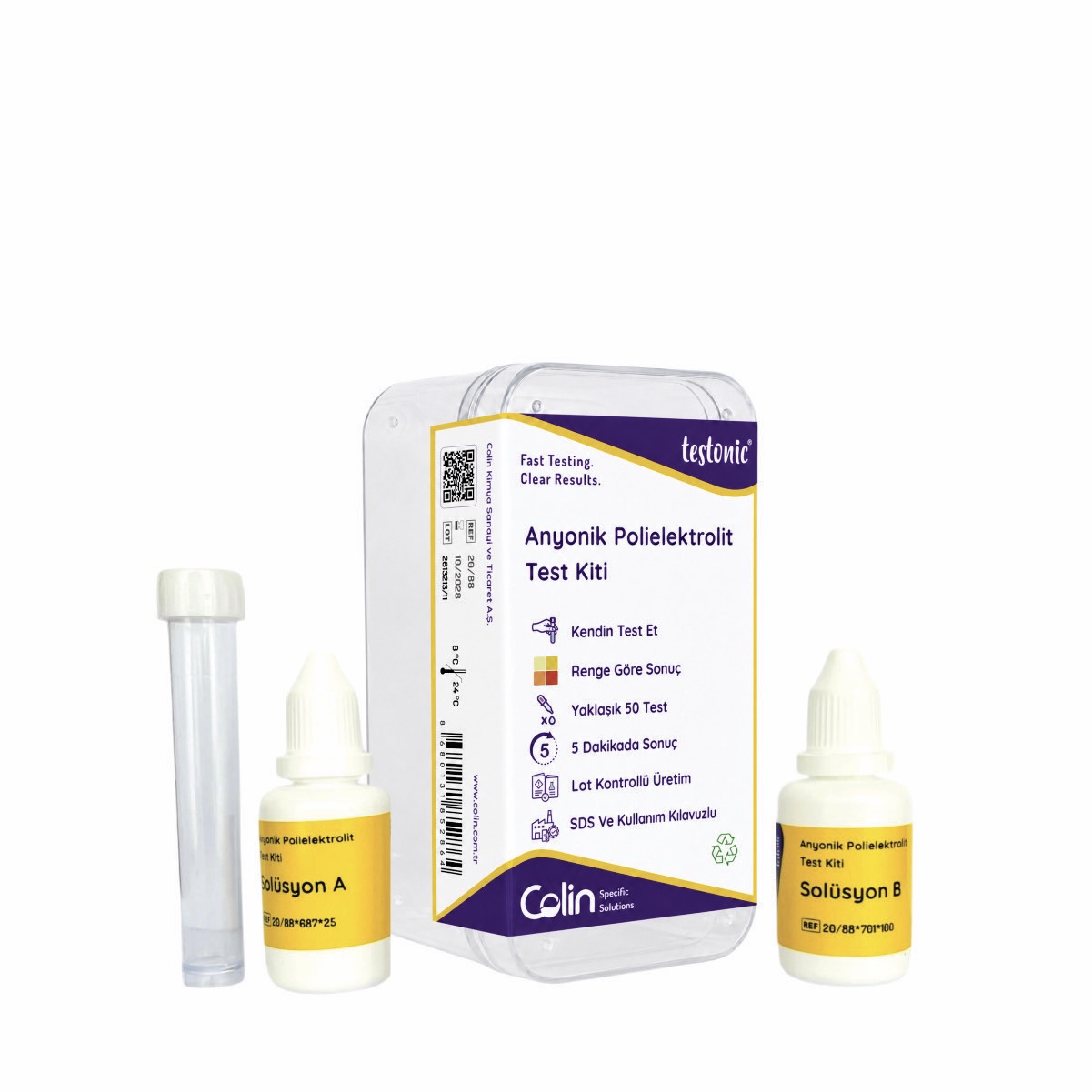
Testonic® Anionic Polyelectrolyte Test Kit is designed for quick and practical detection of possible residues of anionic polyelectrolytes (flocculants) used in water treatment processes. It is particularly suitable for quality control of industrial process water, treated water and liquid salt solutions used in textile dyehouses.
The visual color reaction method eliminates the need for expensive laboratory instruments or complicated analytical procedures. Results are obtained in approximately 5 minutes by evaluating the color change in the sample. The kit offers a practical solution for comparing liquid salt batches, monitoring water treatment processes and checking potential polymer carryover before production.
Why Is Polyelectrolyte Residue Monitoring Important?
Anionic polyelectrolytes are used in water treatment to promote particle aggregation and settling. However, polymer residues carried into treated water or liquid raw materials may affect filtration behavior and production quality in certain processes. Regular monitoring of liquid salt solutions used in textile dyehouses helps identify potential raw material-related process issues.
Polyelectrolyte Testing in 3 Easy Steps
- Prepare the Sample: Fill the graduated test tube with the specified volume of water or liquid sample.
- Perform the Test: Add Solution A and Solution B in the sequence specified in the instructions and mix as directed.
- Evaluate the Result: Interpret the resulting color reaction according to the instructions for use.
Kit Contents
- Anionic Polyelectrolyte Test Solution A
- Anionic Polyelectrolyte Test Solution B
- Graduated Test Tube
- Instructions for Use
Testonic® Anionic Polyelectrolyte Test Kit – Polymer Residue Monitoring in Water and Liquid Salt Solutions
Testonic® Anionic Polyelectrolyte Test Kit is a visual color reaction test designed to detect possible residues of anionic polyelectrolytes and flocculants used in water treatment processes. It is suitable for treated water, industrial process water and appropriate liquid raw materials.
The kit is particularly useful for incoming quality control of liquid salt solutions used in textile dyehouses, industrial water treatment systems and process monitoring. It provides practical residue screening in approximately 5 minutes without electronic analytical instruments.
Analytical Principle
The test is based on evaluating the visual color reaction produced when anionic polyelectrolytes in suitable liquid samples interact with the test reagents.
Solution A and Solution B are applied to the sample in the specified sequence. The resulting appearance is interpreted according to the product instructions.
The method is intended for qualitative screening of anionic polyelectrolyte residues and does not provide a direct numerical polymer concentration in ppm.
Why Is Polyelectrolyte Residue Monitoring Important?
Anionic polyelectrolytes are polymer-based flocculants used in water treatment to promote the aggregation and settling of suspended particles. Although most of the polymer is normally removed with the sludge, some process conditions may allow polymer carryover into the liquid phase.
Depending on the polymer type and concentration, these residues may influence filtration behavior, surface interactions and subsequent manufacturing operations.
Monitoring liquid salt solutions used in reactive textile dyeing is particularly important. Some liquid salt producers use treatment chemicals such as polyaluminium chloride (PAC) and anionic polyelectrolytes to remove suspended impurities.
Checking for possible polymer carryover after treatment makes it easier to compare salt batches and investigate potential raw material-related process variations.
Applications
- Water treatment plants: Sample monitoring before and after flocculant treatment stages.
- Industrial process water: Evaluation of potential anionic polymer carryover.
- Textile dyehouses: Quality control of process water and liquid salt solutions before dyeing.
- Liquid salt producers: Batch monitoring after treatment and filtration processes.
- Chemical manufacturing: Comparison of suitable liquid raw materials and process samples.
- Quality control and R&D: Evaluation of different raw material sources and treatment conditions.
How to Use
- Sample Preparation: Fill a clean test tube with the sample volume specified in the instructions.
- Reagent Application: Add Solution A and Solution B in the specified sequence and quantities, then mix as instructed.
- Result Evaluation: Observe the resulting color reaction and compare it with the interpretation criteria provided in the instructions.
Note: Follow the product instructions for sample volume, reagent quantities and reaction time.
Technical Specifications
| Property | Description |
| Product | Anionic Polyelectrolyte Test Kit |
| Test Parameter | Anionic polyelectrolyte / flocculant residues |
| Analytical Method | Visual color reaction |
| Result Type | Qualitative residue screening |
| Sample Type | Water, process water and suitable liquid salt solutions |
| Test Time | Approximately 5 minutes |
| Test Capacity | Approximately 50 tests |
| Instrument Required | No |
| Kit Contents | Solution A, Solution B, test tube and instructions for use |
Interpretation of Results
The visual reaction is interpreted according to the evaluation criteria provided in the product instructions.
- Positive reaction: Indicates the possible presence of anionic polyelectrolyte-type substances that respond to the test method.
- Negative reaction: Indicates that no significant reaction was observed under the test conditions. It does not prove the complete absence of all polymers.
- Sample comparison: Samples from different production batches or treatment stages can be compared under identical test conditions.
When precise polymer concentrations or trace-level quantitative measurements are required, an appropriate laboratory analytical method should be used.
Analytical Interferences and Measurement Limitations
- Natural sample color and turbidity may interfere with visual interpretation.
- High salt concentrations and the ionic composition of the sample may affect the test reaction.
- Other ionic polymers and certain process chemicals may cause interference.
- Different polyelectrolyte types may not produce identical visual responses.
- The method does not identify every polymer separately or provide an exact concentration in ppm.
For highly saline samples, suitability of the test for the specific sample matrix should be evaluated using reference samples and appropriate controls.
Related Process and Residue Parameters
Anionic polyelectrolyte monitoring is one part of liquid raw material and treated water quality evaluation. Depending on process conditions, additional parameters may require monitoring:
- Turbidity: Monitoring suspended particles in water or liquid salt.
- pH: Evaluation of treatment and flocculation conditions.
- Conductivity: Monitoring the total ionic content of the solution.
- Aluminium: Residue monitoring in processes using aluminium-based coagulants.
- Other polymers: Separate monitoring of cationic or structurally different polymers when required.
Important Application Notes
- Use a clean test tube for each analysis.
- Follow the specified sample and reagent quantities.
- Apply identical test conditions when comparing different batches.
- Interpret results carefully for highly colored, turbid or saline samples.
- Use the kit for rapid residue screening rather than exact quantitative polymer analysis.
Frequently Asked Questions
Test and Process Control Kits for Textile Finishing and Dyeing Mills
Checks anionic polyelectrolyte traces in brine, process water or treatment lines, supporting monitoring of flocculation, gelling and carryover risks.
Technical Documents
Related Posts
Related News
Technical Support and Product Consulting
You can use the form to find the most suitable chemical solution for your needs or to obtain detailed information about the technical specifications of our products.
Your requests are carefully reviewed and answered by Colin's expert team.
You can ask us about the product.