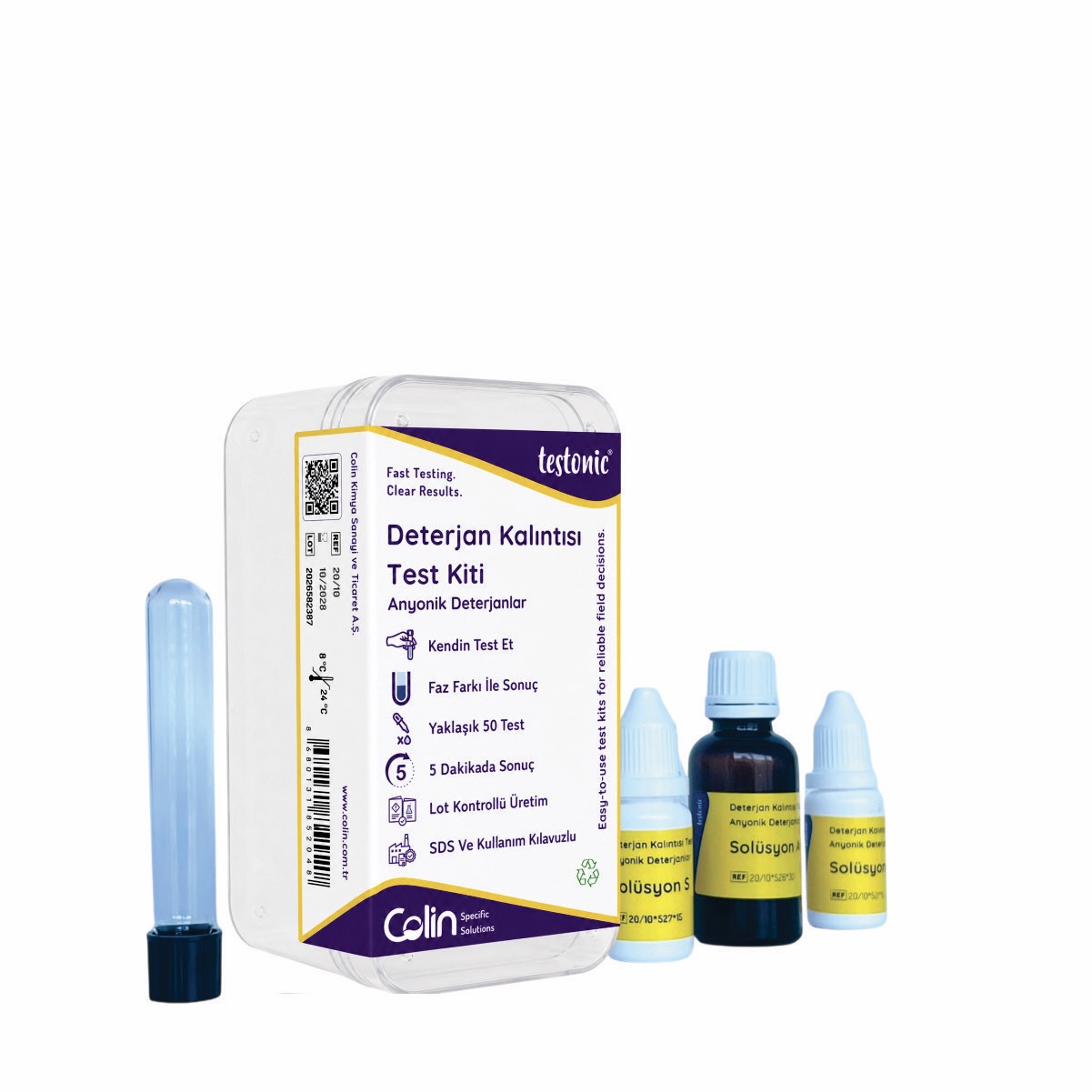
Testonic® Detergent Residue Test Kit – Anionic Detergents is designed for quick and practical detection of anionic detergent and surfactant residues in water and suitable liquid samples after cleaning and rinsing operations.
Ideal for rinse water monitoring in CIP systems, food processing equipment, tanks, pipelines and industrial washing operations. The visual phase separation method provides results in approximately 5 minutes without laboratory instruments. It allows users to evaluate whether anionic cleaning chemicals have been sufficiently removed during rinsing.
Why Is Detergent Residue Monitoring Important?
Visibly clean surfaces do not necessarily mean that all cleaning chemicals have been removed. Insufficient rinsing may leave anionic surfactant residues that can cause unwanted chemical contamination in subsequent production and hygiene processes. Regular detergent residue monitoring makes it easier to evaluate rinsing effectiveness and monitor cleaning operations.
Detergent Residue Testing in 3 Easy Steps
- Prepare the Sample: Fill the capped test tube with the specified volume of rinse water or a suitable liquid sample.
- Perform the Test: Add the kit solutions in the sequence and quantities specified in the instructions. Mix the tube as directed.
- Evaluate the Result: Observe the resulting phase separation and color difference to check for anionic detergent residues.
Kit Contents
- Anionic Detergent Test Solution S
- Anionic Detergent Test Solution A
- Anionic Detergent Test Solution B
- Capped Test Tube
- Instructions for Use
Testonic® Detergent Residue Test Kit – Anionic Detergents
Testonic® Anionic Detergent Residue Test Kit is a practical visual phase separation test designed to detect residual anionic detergents and surfactants in water and suitable liquid samples after cleaning and rinsing operations.
It is suitable for rinse water monitoring in CIP systems, food processing equipment, tanks, pipelines and industrial washing processes. The kit provides qualitative residue evaluation in approximately 5 minutes without laboratory instruments.
Analytical Principle
The test is based on the visual evaluation of phase separation and color differences produced when anionic detergents and surfactants in the sample react with the test reagents.
After applying the kit solutions, the appearance and color distribution of the resulting phases are examined. Results are interpreted according to the evaluation criteria in the product instructions.
The method is intended for qualitative monitoring of anionic detergent residues. It is not a titrimetric method that directly measures detergent concentration in ppm.
Why Is Detergent Residue Monitoring Important?
After cleaning, removing visible contamination is important, but the cleaning chemical must also be removed during rinsing. Insufficient rinsing may leave surfactant residues that can cause unwanted chemical contamination in subsequent production stages.
Testonic® Anionic Detergent Residue Test Kit provides a practical way to evaluate rinsing effectiveness in processes using cleaning agents containing anionic surfactants.
Three stages should be considered together:
- Cleaning: A cleaning chemical containing anionic detergent is applied.
- Rinsing: The cleaning chemical is intended to be removed from the system.
- Residue Monitoring: Remaining anionic detergent in rinse water is checked using visual phase differences.
Applications
- CIP systems: Monitoring final rinse water after cleaning operations.
- Food and beverage manufacturing: Cleaning and rinsing control of production equipment.
- Tanks and pipelines: Residue monitoring after washing with anionic detergents.
- Industrial washing: Monitoring cleaning processes involving anionic surfactants.
- Equipment sanitation: Chemical residue monitoring in suitable liquid samples.
- Quality control: Routine rinsing and process verification applications.
How to Use
- Sample Preparation: Fill a clean capped test tube with the specified volume of rinse water or a suitable liquid sample.
- Reagent Application: Add Solution S, Solution A and Solution B in the sequence and quantities specified in the instructions. Mix the sample as directed.
- Result Evaluation: Observe the resulting phase separation and color differences to evaluate anionic detergent residues.
Note: Follow the product instructions for reagent addition sequence, mixing procedure and reaction time.
Technical Specifications
| Property | Description |
| Test Parameter | Anionic detergent / surfactant residues |
| Analytical Method | Visual phase separation and color difference |
| Result Type | Qualitative residue monitoring |
| Sample Type | Rinse water and suitable liquid samples |
| Application | Anionic detergent residue monitoring after cleaning |
| Test Time | Approximately 5 minutes |
| Test Capacity | Approximately 50 tests |
| Instrument Required | No |
| Storage Temperature | 8–24 °C |
| Kit Contents | Solution S, Solution A, Solution B, capped test tube and instructions for use |
Interpretation of Results
The color difference between the resulting phases is interpreted according to the evaluation criteria specified in the product instructions.
- Positive reaction: Indicates the possible presence of anionic detergent or surfactant residues that respond to the test method.
- Negative reaction: Indicates that no significant anionic detergent reaction was observed under the test conditions. It does not prove that all cleaning chemicals have been completely removed.
- Comparative monitoring: Rinse water samples collected at different stages can be compared using the same method to monitor changes during rinsing.
The test should not be used as a substitute for quantitative concentration measurement or microbiological hygiene verification.
Analytical Interferences and Measurement Limitations
- Other surfactants and certain process chemicals may affect the test reaction.
- Highly colored, turbid or emulsified samples may make phase separation difficult to evaluate.
- Sample pH and ionic composition may affect the method's response.
- Different anionic detergent types may not produce identical visual reaction intensities.
- A negative result does not indicate the complete absence of all detergent and disinfectant residues.
The kit is intended for rapid screening of anionic surfactant residues. An appropriate quantitative analytical method should be used when precise concentration determination is required.
Related Residue and Hygiene Parameters
Different residue tests may be required depending on the cleaning chemical used. Chemical residue monitoring should also be evaluated separately from organic soil removal and disinfection effectiveness.
| Control Parameter | Testonic® Test Kit |
| Anionic detergent residues | Anionic Detergent Residue Test Kit |
| Nonionic detergent residues | Nonionic Detergent Residue Test Kit |
| QAC / cationic detergent residues | QAC / Cationic Detergent Residue Test Kit |
| Acid / alkaline residues | Chemical Residue Test Kit – Acid / Alkaline |
| Protein residues | Protein Residue Test Kit |
| Oil / lipid residues | Oil and Lipid Residue Test Kit |
| Starch residues | Starch Residue Test Kit |
Important Application Notes
- Perform the test using clean and suitable liquid samples.
- Do not change the specified sample volume or reagent addition sequence.
- Evaluate phase separation after the reaction time specified in the instructions.
- Select the test based on the anionic surfactant content of the cleaning chemical.
- For food-contact surfaces, follow the cleaning verification procedures established by the operator when determining suitability.
- Do not interpret the result as proof of microbiological cleanliness or sterility.
Frequently Asked Questions
Hygiene and Safety Tests for Catering and Food Businesses
Detects anionic detergent residue on surfaces and equipment.
Test and Process Control Kits for Textile Finishing and Dyeing Mills
Checks anionic surfactant and detergent residues, helping evaluate washing efficiency, rinsing adequacy, foaming and compatibility with subsequent processes.
Testonic® Dyehouse Control Pack
Checks anionic detergent and surfactant residues. Important for evaluating washing and rinsing adequacy, foaming risk and compatibility with subsequent chemical processes.
Technical Documents
Technical Support and Product Consulting
Customer Questions & Expert Answers
About anionic detergent residue in textile finishing
You can ask us about the product.