


Technical Overview
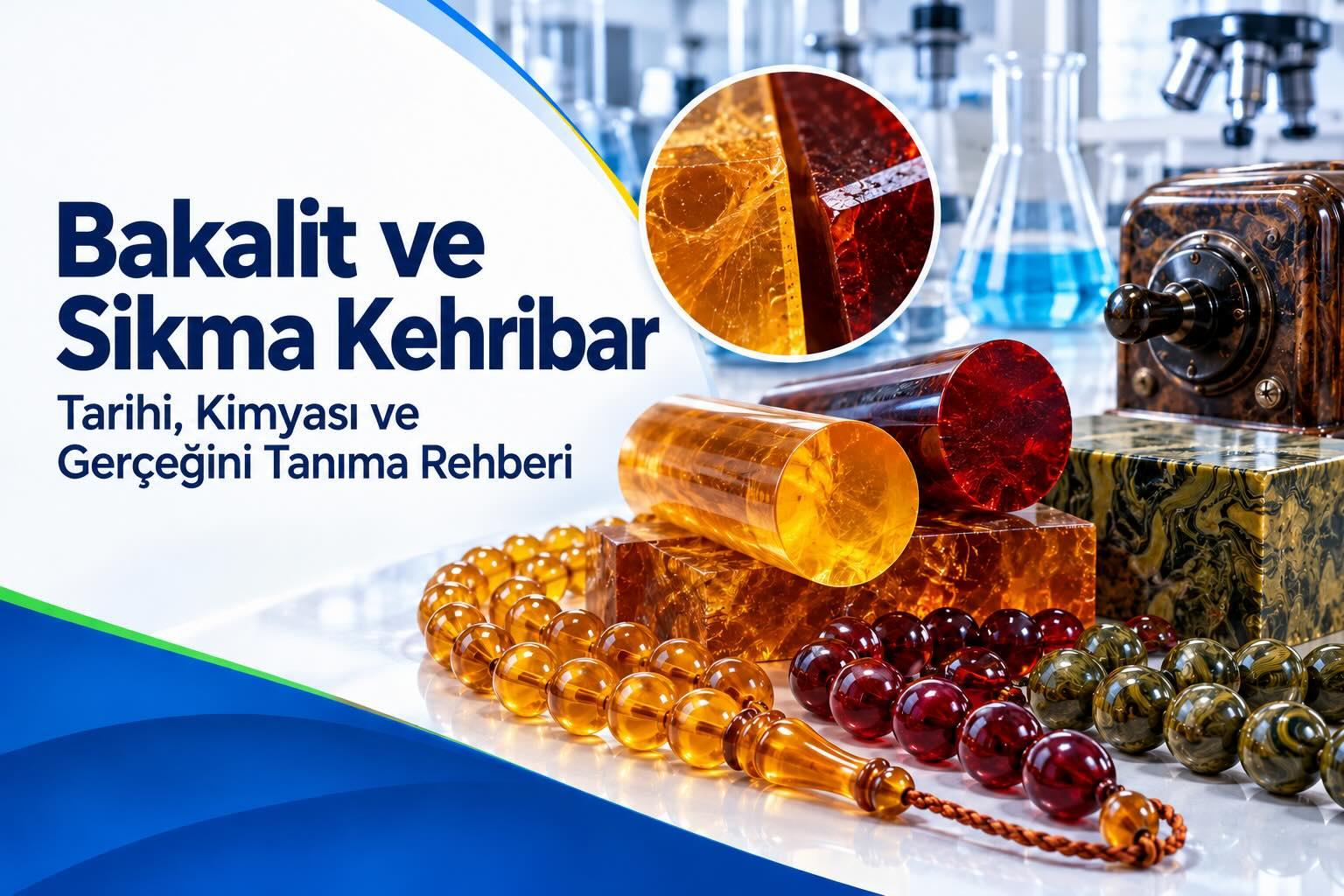
Two prayer beads may look almost identical in honey yellow, cherry red or deep olive green. Yet one may be natural amber, another a cured phenol-formaldehyde resin from the Bakelite family, and a third an epoxy or acrylic product. Similar appearance does not mean the materials are chemically identical.
This guide explores the history of Bakelite, what makes cured phenolic resins different, why craftspeople choose them for beads, and which practical checks buyers can perform without damaging a finished item. Color, smell or any single home test should never be treated as definitive proof of identity.
The Historic Colors of Bakelite
One reason cast phenolic resins became popular in jewelry and prayer beads is their rich range of colors, from golden amber to cherry red and olive green. The following palette takes its inspiration from historic Bakelite jewelry-quality color samples.
A color, swirl pattern or degree of transparency cannot, by itself, establish that a product is phenolic resin.
Contents
What Is Bakelite? Is It the Same as “Sıkma Kehribar”?
Bakelite® is the historic trade name associated with the early phenol-formaldehyde thermosetting resin technology developed by Leo Hendrik Baekeland. The word is also used more broadly in everyday commerce for different types of cured phenolic material. A thermoset is a polymer that develops a cross-linked network during curing and cannot simply be remelted and molded again under normal processing conditions.
In Türkiye, the expression “sıkma kehribar” is often used in the prayer-bead trade for synthetic phenolic resin materials. However, in gemology, pressed or reconstructed amber (ambroid) refers to genuine amber fragments bonded together by heat and pressure. These are fundamentally different materials. Natural amber is fossilized ancient tree resin, not a phenol-formaldehyde polymer. [1, 3, 4]
Bakelite is a type of plastic. What makes it different from many common plastics is its phenolic chemistry and cross-linked thermoset structure. Since cured epoxies can also be thermosets, “it does not melt, therefore it must be Bakelite” is not a valid identification rule.
From a Chemical Invention to Prayer Beads: The History of Bakelite
The story of phenolic resin is also part of the history of materials designed to replace scarce, costly or fragile natural substances. Its applications eventually extended far beyond industrial components into jewelry, decorative objects and prayer beads.
Early semi-synthetic plastics such as celluloid gain commercial importance.
Leo Hendrik Baekeland develops the phenol-formaldehyde material known as Bakelite.
Patents, scientific presentations and industrial commercialization follow.
An early documented reference mentions Faturan, a phenolic imitation-amber material.
Colorful cast phenolics and Catalin become popular in jewelry, radios and decorative products.
Early industrial Bakelite was widely associated with telephone housings, electrical switches and radio cabinets. Later, unfilled or specially formulated cast phenolic resins made colorful, translucent and marbled decorative products possible. Catalin is among the best-known historical examples. Not every Bakelite-family product is dark or filled with wood flour or fibers. [1, 6]
Faturan and the claim of “Ottoman-era” phenolic beads
Faturan was the name of an early phenol-formaldehyde-based material used as an imitation of amber. The name appears in documents from 1913–1914. Thus it is too absolute to claim that phenolic beads could not possibly have existed during the late Ottoman period: industrial production and the final Ottoman years overlap. Researchers have also considered the possibility that Faturan reached Ottoman markets. Nevertheless, the age of a bead sold today as “Ottoman” or “original Faturan” cannot be determined from color or polymer identity alone. Reliable provenance is needed. [5]
What Happens When a Resole Phenol-Formaldehyde Resin Cures?
Resole resins are generally prepared under alkaline conditions with an excess of formaldehyde. During curing, chemical bridges form between resin molecules, producing a three-dimensional polymer network. The starting resin becomes a hard, dimensionally stable material. Novolac resins are typically prepared under different conditions and generally need an added cross-linking agent to cure fully. Therefore, not every cured phenolic article necessarily began as a resole. [2]
1. Processable Resin
A phenolic resin prepared for casting or shaping before its final network has formed.
2. Controlled Curing
Cross-links develop under suitable temperature and processing conditions.
3. Cured Phenolic Solid
A thermoset that can provide good hardness, dimensional stability and machinability.
Unlike thermoplastics such as acrylic (PMMA), fully cured phenolics cannot simply be melted and reshaped. They may decompose or char at excessive temperatures. Yet cured epoxy is also a thermoset, so resistance to remelting cannot identify phenolic resin on its own.
Bakelite vs. Epoxy, Acrylic and Natural Amber
The decisive differences lie in chemical origin and material behavior, not merely in color or polish.
| Property | Phenolic Bakelite | Cured Epoxy | Acrylic (PMMA) | Natural Amber |
|---|---|---|---|---|
| Origin | Phenol-formaldehyde polymer | Epoxy resin system | Synthetic thermoplastic | Fossilized tree resin |
| Heating | Does not remelt; may decompose | Does not remelt; may decompose | Can soften when heated | Heat-sensitive natural resin |
| Appearance | Opaque, translucent, marbled | May be clear or colored | Often very clear; colorable | Natural patterns and inclusions |
| Aging | Some formulations darken | Some systems yellow | Depends on UV stabilization | Surface may oxidize and darken |
| Verification | Material records / ATR-FTIR | Material records / ATR-FTIR | Material records / ATR-FTIR | Gemological and spectroscopic methods |
Phenolic resins can offer useful heat and dimensional stability, electrical insulation, surface hardness and machining characteristics. However, some grades are brittle. Properties depend on formulation, fillers, curing and service conditions rather than the word “Bakelite” alone. [7, 8]
Why Choose Phenolic Bakelite Instead of Natural Amber?
Price is only part of the story. Craftspeople also value the availability of workable stock, color selection, decorative effects and predictable processing.
Colors and Patterns
Honey, cherry, olive, orange and marbled effects offer considerable design freedom.
Turning and Polishing
Appropriately cured rods and blocks may be machined, drilled and polished into precise shapes.
Predictable Supply
Larger pieces and selected colors can be sourced more consistently than rare natural amber stock.
Economic Choice
Useful for larger decorative components and repeat production where cost matters.
Historical Identity
Bakelite, Faturan and Catalin have their own place in twentieth-century design history.
Distinctive Patina
Some older phenolics darken with age; this characteristic varies and is never guaranteed.
Its geological origin, fossil inclusions and natural formation cannot be reproduced by synthetic phenolic resin. Both materials deserve accurate descriptions and transparent sales claims.
Practical Checks When Buying Cured Phenolic Material
There is no single home observation that conclusively identifies phenolic resin. Use the following checks as screening tools and assess their results together.
1. Ask for a clear material description
Ask whether the item is cured phenol-formaldehyde resin, natural amber or reconstructed natural amber. Request the manufacturer, product identification and batch information when available. Claims such as “original Faturan” or “Ottoman antique” require separate historical evidence.
2. Measure density for numerical screening
Weigh a dry sample and determine its volume, either from known dimensions or the volume of water displaced by full immersion.
Example: 12.8 g ÷ 10.0 mL = 1.28 g/mL
Approx. 1.05–1.10 g/mL
Example range 1.24–1.32 g/mL
1.35–1.38 g/mL reported
These are indicative ranges, not acceptance limits. Fillers and formulations affect density, and epoxy or polyester grades may overlap. Small beads introduce considerable volume-measurement error; use a suitably sized piece or several samples where practical. [3, 7, 8]
3. Saturated Saltwater
Natural amber typically floats in a properly prepared saturated salt solution, while many phenolic resins sink. But floating does not prove natural amber, and sinking does not prove Bakelite. Air bubbles, coatings and other materials may mislead. Avoid testing valuable or delicate items. [3]
4. Long-Wave UV (365 nm)
Some natural amber shows blue or greenish fluorescence; some phenolics react differently. Yet dyes, coatings and formulation changes prevent a universal color rule. Protect your eyes and never stare into the UV source. [9]
5. Examine the surface and a reference cross-section
Record color, transparency, swirl marks, bubbles, cracks and polishing quality. Some aged phenolics have a darkened outer layer with a lighter interior. However, no one visual feature proves phenolic composition or historical origin. A sample offcut provided by the manufacturer is preferable to damaging a finished collectible. [5, 7]
ATR-FTIR infrared spectroscopy is a powerful method for separating phenolic resin from amber, acrylic and many other plastics. Raman spectroscopy and additional methods may be used when needed. A phenolic spectrum, however, does not establish the object's production year or original trade brand. [5, 9]
Common Myths and Unreliable “Bakelite Tests”
| Common Claim | Scientific Assessment |
|---|---|
| “Bakelite never burns.” | Phenolics can char, but are not absolutely noncombustible. Fire behavior depends on formulation and conditions. |
| “A hot needle cannot penetrate real Bakelite.” | Other thermosets may behave similarly. A hot needle damages the product and can generate hazardous fumes. |
| “Bleach color change proves authenticity.” | It is not a valid identification method. Oxidizers may permanently damage the surface. |
| “Bakelite cannot attract paper after rubbing.” | This is static electricity, not magnetism. Phenolic materials may also acquire a triboelectric charge. |
| “A phenolic smell is conclusive proof.” | Odor may offer clues but is not a definitive test. Do not deliberately inhale machining dust or heated fumes. |
| “Every authentic piece eventually turns cherry red.” | Only some formulations darken in that way. Rate and color vary with composition and aging conditions. |
| “If it does not melt, it cannot be epoxy.” | False. Fully cured epoxy is also a thermoset. |
Do not use open flames, heated needles, excessive heat, strong acids, bleach or aggressive solvents on finished beads, especially valuable or historical examples. Such methods can cause irreversible damage and hazardous exposure. [7, 10]
Why Does Some Bakelite Change Color with Age?
Some phenolic formulations gradually change from yellow to amber, reddish brown or dark brown. Light, oxygen, heat, catalysts and other formulation factors may influence the process. Historical research documents older beads whose outer surfaces darkened more than their interiors. Yet there is no universal color-change schedule for phenolic resin. Other formulations were deliberately designed for better color stability. [5, 6, 7]
Increased gloss during handling may result from repeated friction and polishing; the material is not literally transforming into glass. Sweat, skin oils and handling habits may affect appearance, but a personalized color response is not an authenticity certificate. Natural amber can also oxidize and darken with age. [3]
Yellow, gold or caramel
Orange and brown tones
Cherry red and deeper shades
Turning, Drilling and Polishing: Quality and Safety
Suitable cured phenolic rods and blocks can be machined into beads and decorative pieces. Their behavior depends on resin type, cure, fillers and tooling; some grades may be relatively brittle.
Dust generated by cutting, drilling or sanding should not be inhaled. Use appropriate local dust extraction, ventilation, eye protection and respiratory protection selected for the exposure conditions. Overheating or burning may produce hazardous decomposition products. Follow the manufacturer's technical and safety guidance. [10]
A quality material is more than a glossy surface. Look for a clear chemical description, controlled curing, consistent machining behavior and traceable production information.
Frequently Asked Questions
Conclusion: The Value of Bakelite Begins with Accurate Identification
Bakelite is more than a lower-cost imitation of natural amber. It represents a landmark in synthetic polymer history, a long-established industrial thermoset and a distinctive material for skilled beadmakers. Products made from properly cured resole phenol-formaldehyde resin can offer useful color variety, machinability and dimensional stability, depending on formulation and processing.
Color change, characteristic odor, charring and static electricity are not definitive identification tests. Natural amber, reconstructed amber and synthetic phenolic Bakelite should each be described and sold under their true material identity.
Identify Bakelite by Its Material Chemistry, Not Appearance Alone
Clear material identification, traceable production and analytical verification when needed are the strongest foundations of trust for both craftspeople and buyers.
References and Further Reading
- American Chemical Society — Leo Baekeland and the Invention of Bakelite.
- Global Phenolic Resins Association — Phenolic Resins: What Are They?
- Gemological Institute of America — Amber and Amber Buyer's Guide.
- Amber Museum — Amber Pressing.
- Falabella, R. & Kaspers, F. (2020) — A Faturan Phenolic Resin Bead Sample Card, The Bead Forum, 77.
- Museum of Fine Arts, Boston / CAMEO — Catalin.
- Falabella, R. (2016) — Imitation Amber Beads of Phenolic Resin from the African Trade, BEADS, 28, 3–15.
- eFunda — Phenolic: Unfilled Casting Resins.
- GIA, Gems & Gemology (2017) — Plastic Amber Imitation in a Rosary.
- U.S. Consumer Product Safety Commission — Art and Craft Safety Guide.
