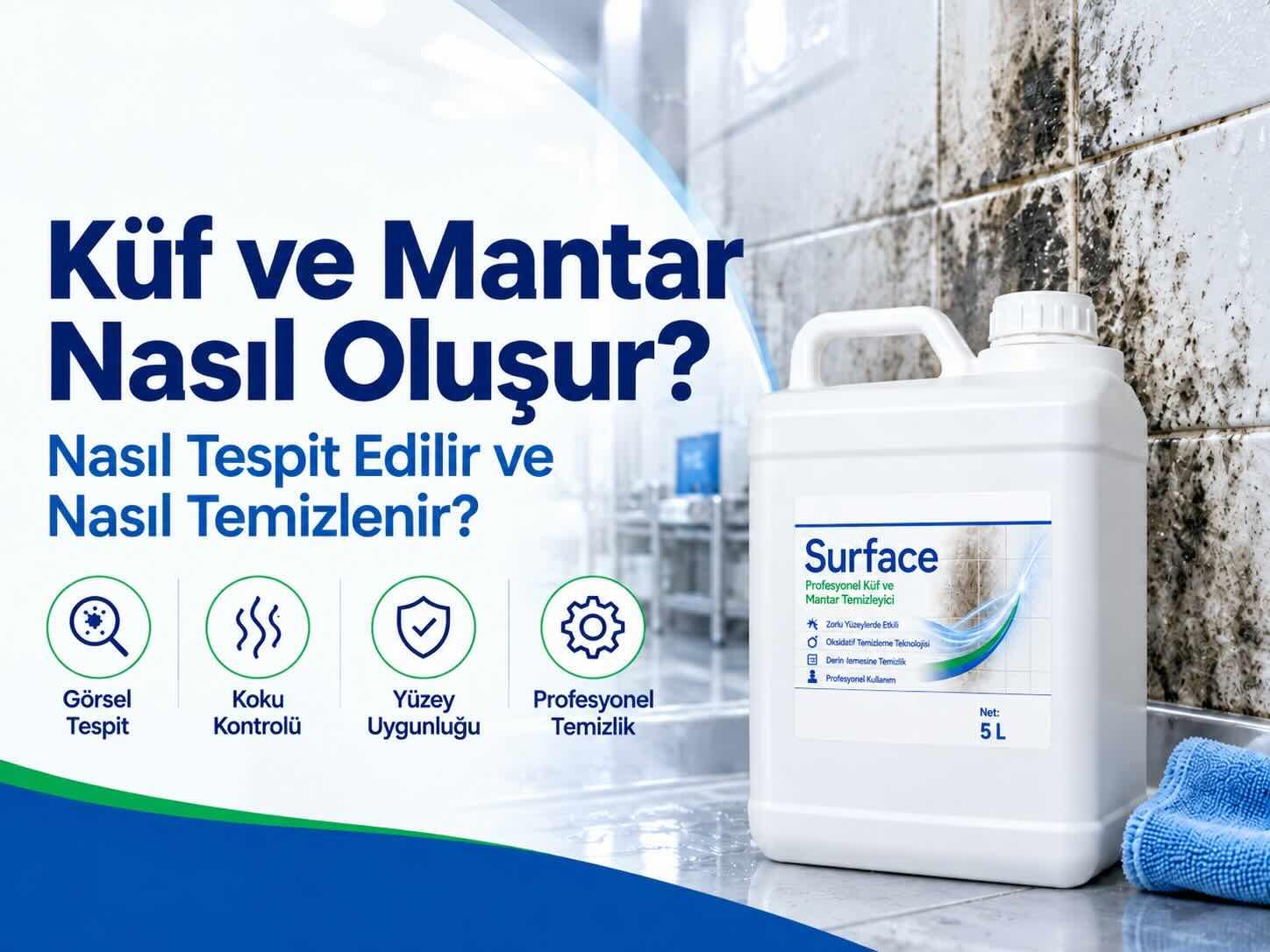
How Do Mold and Fungi Develop, How Can They Be Detected and Cleaned?
Quick Summary
Surface contamination associated with mold and fungal growth is most commonly related to humidity, condensation, water leakage, inadequate ventilation or surfaces remaining wet for extended periods. The problem may become noticeable through black, gray, greenish or brown stains, surface discoloration and a characteristic damp or musty odor. Effective control involves not only cleaning the visible staining, but also identifying the source of moisture, applying an appropriate surface-cleaning method and keeping the surface dry afterwards.
Contents
What Are Mold and Fungi?
Technically, molds are filamentous microorganisms belonging to the kingdom Fungi. Although the terms "mold and fungi" are often used together in everyday language, mold describes a particular form of fungal growth.
Mold spores occur naturally in the environment and can enter indoor spaces through air movement, dust, people, materials and contact with outdoor environments. The presence of spores on a surface does not by itself indicate an active mold problem. The critical factor is the development of sufficient moisture and suitable environmental conditions that allow spores to grow.
How Do Mold and Fungi Develop?
One of the most important requirements for mold growth is moisture. When a surface or building material remains damp for an extended period, naturally occurring fungal spores may find suitable conditions for development.
Direct contact with water is not always necessary. High humidity in the air may condense on colder surfaces and create sufficient moisture for growth.
Main Factors That Promote Mold Growth
- High indoor humidity
- Water and plumbing leaks
- Roof or façade water penetration
- Rising or capillary dampness in walls
- Condensation
- Inadequate ventilation
- Slow drying of wet surfaces
- Thermal bridges and cold surface temperatures
- Organic dirt and residues on surfaces
- Insufficient air circulation between walls and stored materials
Where Do Mold and Fungi Commonly Develop?
Mold is not limited to residential buildings. It may occur in industrial facilities, warehouses, hotels, basements and technical areas wherever moisture is not adequately controlled.
Bathrooms and Wet Areas
Grout lines, corners, shower areas and surfaces continuously exposed to water vapor may be particularly susceptible because of high humidity.
Basements and Technical Areas
Areas with limited air circulation, low surface temperatures and elevated structural moisture may provide favorable conditions.
Warehouses
Materials stored directly against walls, enclosed areas and localized moisture that remains unnoticed for long periods may contribute to mold growth.
Production Facilities
Washing operations, steam, process water, temperature differences and technical surfaces that remain wet can create favorable conditions.
Cold Surfaces
When warm, humid air contacts a cold surface, condensation may create a continuous source of moisture even when there is no water leak.
Behind Walls, Cabinets and Equipment
Limited air movement behind cabinets, machinery, shelving and other equipment may allow moisture problems to remain unnoticed.
How Can Mold and Fungal Growth Be Detected?
Mold problems can often be identified initially through visual signs, odor and evidence of moisture without laboratory testing. However, not every dark stain is mold. Soot, grease, rust, mineral deposits and other types of contamination may produce similar appearances.
1. Visual Inspection
Mold-related surface growth may appear in different colors depending on the species, surface and environmental conditions:
- Black or dark gray spots
- Greenish staining
- Brown discoloration
- White or light-colored surface growth
- Scattered spot-like formations
- Irregular darkening spreading across a surface
2. Detection by Odor
Even when no visible staining is present, a characteristic damp, earthy or musty odor may indicate hidden moisture and possible microbial growth.
In enclosed cabinets, behind walls, above suspended ceilings, in warehouse corners and in areas with poor air circulation, odor may be the first noticeable sign.
3. Moisture and Condensation Signs
The following signs may indicate conditions favorable for mold development:
- Water stains
- Blistering or peeling paint
- Deterioration of plaster
- Persistent condensation on windows or pipes
- Damp wall surfaces
- Recurring wet areas
4. Moisture Measurement
In professional applications, relative humidity meters, surface moisture meters and suitable building-moisture measurement equipment can help identify the source and extent of a moisture problem.
5. Is Laboratory Analysis Necessary?
When mold growth is visible and characteristic, laboratory identification is not always necessary simply to decide whether cleaning is required. However, recurring industrial problems, quality assurance investigations, suspected hidden contamination or situations where the source cannot be identified may justify sampling and laboratory analysis.
Why Should Mold and Fungal Growth Be Cleaned?
Mold-related surface contamination should not be considered only an aesthetic issue. Persistent moisture and microbial growth may affect both building materials and indoor environmental quality.
Surface Appearance
Dark stains, discoloration and irregular surface appearance can make an area look poorly maintained and difficult to clean.
Material Deterioration
Persistent moisture may accelerate deterioration of paint, plaster, grout and certain porous building materials.
Odor Problems
Moisture and microbial growth may produce persistent and unpleasant odors in enclosed areas.
Indoor Environmental Quality
Persistent dampness and visible mold should be considered when managing the quality of indoor environments, particularly in frequently occupied spaces.
The World Health Organization reports scientific evidence associating persistent building dampness and microbial growth with increased respiratory symptoms, allergic symptoms and asthma. For this reason, persistent dampness and visible mold problems in living and working environments should not be ignored.
What Happens If Mold Is Left Untreated?
If the source of moisture remains and the affected surface is not cleaned, the problem is unlikely to disappear on its own.
Over time:
- The affected area may expand.
- Surface discoloration may become more pronounced.
- The characteristic odor may intensify.
- Cleaning porous surfaces may become more difficult.
- Paints and coatings may blister, peel or deteriorate.
- New growth may develop on other damp and suitable surfaces nearby.
How Should Mold and Fungal Contamination Be Cleaned?
Proper mold cleaning involves more than wiping away visible dark stains. A professional approach should include identifying the source, assessing the surface, applying an appropriate cleaning method and preventing the surface from becoming wet again.
1. Identify the Source of Moisture First
If there is a water leak, plumbing problem, façade penetration, condensation or inadequate ventilation, the underlying cause should be corrected whenever possible before or together with cleaning.
2. Evaluate the Surface Type
Ceramic and other hard surfaces cannot always be treated in the same way as drywall, textiles, ceiling tiles or other porous materials.
Some highly contaminated absorbent and porous materials may require replacement rather than surface cleaning alone.
3. Remove Loose Contamination
Dust, loose debris and other surface residues may reduce direct contact between the cleaning product and the contaminated surface. Pre-cleaning is therefore an important part of professional treatment.
4. Select an Appropriate Cleaning Product
The cleaning product should be compatible with the surface material, used according to its instructions and tested on a small area when the substrate is sensitive or its compatibility is uncertain.
5. Apply Mechanical Action When Necessary
On grout, textured concrete and similar surfaces, appropriate brushing or mechanical cleaning may help remove contamination that has become strongly attached to the surface.
6. Dry the Surface Thoroughly
Leaving the cleaned surface damp for an extended period may create conditions that favor recurrence of the same problem.
How to Clean Mold and Fungal Surface Stains with ULTRACOL Surface®
ULTRACOL Surface® - Mold and Fungal Stain Cleaner is developed for the professional cleaning of dark surface stains, contamination associated with mold and fungal growth, and difficult organic-type residues commonly encountered in humid environments.
The objective is not simply to wet the surface, but to apply the product under controlled conditions on a compatible surface.
| Step | Application |
|---|---|
| 1. Inspect the surface | Evaluate the surface type, degree of contamination and the presence of any coating or paint system. |
| 2. Pre-clean | Remove loose dirt, dust and other surface residues as thoroughly as possible. |
| 3. Compatibility test | Especially on sensitive, painted or specially coated surfaces, test first on a small inconspicuous area. |
| 4. Apply the product | Apply ULTRACOL Surface® to the contaminated area according to the product label and technical application instructions. |
| 5. Contact period | Follow the application and contact conditions specified in the product instructions. |
| 6. Mechanical assistance | For old or intensive staining, an appropriate brush or cleaning tool may be used if compatible with the surface. |
| 7. Final treatment | Clean or rinse the surface according to the product instructions and allow it to dry as completely as possible. |
Surface Compatibility
Not all materials have the same resistance to cleaning chemicals. Natural stone, metals, painted surfaces, special coatings, textiles, wood and materials sensitive to discoloration should be evaluated for compatibility before application.
How Can the Recurrence of Mold Be Reduced?
If mold reappears in the same location within weeks or months after successful cleaning, the underlying problem is usually related not to the cleaner itself, but to persistent environmental conditions.
- Repair water and plumbing leaks.
- Check roofs and external façades for water penetration.
- Reduce conditions that cause condensation.
- Improve ventilation.
- Allow wet surfaces to dry as quickly as possible.
- Avoid placing shelving, cabinets or equipment directly against walls.
- Monitor relative humidity in problem areas.
- Investigate structural moisture when localized staining repeatedly returns.
- Establish periodic surface-inspection programs in professional facilities.
Cleaning + Moisture Control
A sustainable maintenance approach to mold and fungal surface problems has two essential components: proper removal of existing surface contamination and control of the moisture conditions responsible for recurrence.
Frequently Asked Questions
Conclusion
Mold and fungal contamination is often too complex to be treated simply as a "dirty surface." High humidity, condensation, water leakage, structural problems or inadequate air circulation may exist behind the visible discoloration.
The appropriate approach is therefore to detect the problem early, identify the source of moisture, clean the surface using a compatible professional method and keep the area dry afterwards.
In professional and industrial environments, the cleaning method should be selected by considering the extent of contamination, the surface material and the operating conditions together.
ULTRACOL Surface® - Mold and Fungal Stain Cleaner
For the professional cleaning of mold and fungal-related surface stains and difficult organic contamination in humid environments, you can review ULTRACOL Surface® and contact the Colin technical team for information on surface compatibility and industrial application conditions.
References and Technical Resources
- World Health Organization (WHO), Guidelines for Indoor Air Quality: Dampness and Mould.
- U.S. Environmental Protection Agency (EPA), A Brief Guide to Mold, Moisture and Your Home.
- U.S. Environmental Protection Agency (EPA), Mold Cleanup and Moisture Control Guidance.
- Centers for Disease Control and Prevention (CDC), Mold – General Information and Prevention.